Last week, I wrote about my amazing weekend away with friends. And it was exactly that. Amazing.
But the part I neglected to mention is that pushing yourself to the max when you have a chronic illness is exhausting. And not in the “I’m really tired” sense, although there is, of course, regular fatigue to be reckoned with.
So instead of painting a picture with broad, unhelpful strokes, I’ll go ahead and make this image as detailed as possible so you, reader, can understand the full extent of what living with an invisible disability is like.
I’ve known for some time that I have hypermobile Ehlers-Danlos Syndrome (hEDS), a connective tissue disorder that’s the result of my body not producing (or not correctly processing) collagen. What does this mean? Well, it means anything and everything can hurt, ache, overextend, or be injured at just about any time. Tendons, muscles, ligaments, organs — all of it subject to issues cropping up at any time. Folks with hEDS? We’re the ones who injure ourselves by turning our head the wrong way. (It’s not wrong, for the record… It’s just temporarily wrong at that specific moment in time when a ligament, tendon, nerve, or bone has decided it should slip at precisely *that* moment.)
In a normal week, I keep my body in check with the amount of activity I engage in. If I push too hard, do too many loads of laundry at one time, spend too long in the kitchen or at the sink on my feet, I feel it. I develop a bone-deep ache in my entire body that’s only really fixable by sitting or lying down for a few hours. Essentially, this means in order to function in any normal capacity, I must take frequent breaks. To keep up with the regular hullabaloo, I nap almost daily.
But I only had two and a half days last weekend to catch up with friends after 26 years apart. There was a lot of information to cover, hundreds of stories to tell, and so much laughter to be had. So I pushed myself. I pushed far beyond where I should have. And I suffered as a result.
On day 1, I spent six and a half hours in the driver’s seat, which is already painful. Four hundred mg of ibuprofen and a heated seat helped significantly. But my tailbone is prone to shifting at times, so when we stopped for a coffee, I didn’t get out of the driver’s seat because getting out might mean not being able to sit down again. Best not to get up at all. Additionally, holding a steering wheel for this length of time also means my neck, shoulders, and upper back muscles tend to seize up, which they did. Again, the ibuprofen made all of this bearable. I could even forget after a while that my body had a problem at all.
Once at our rented home away from home, the four of us went out for dinner, during which we laughed and talked, ate amazing fare and drank expensive wine. By the end of dinner, my tailbone was screaming. Hard restaurant dining room chairs are not meant for people with mobile tailbones… (Hmm. I suspect tailbones aren’t meant to be mobile.)
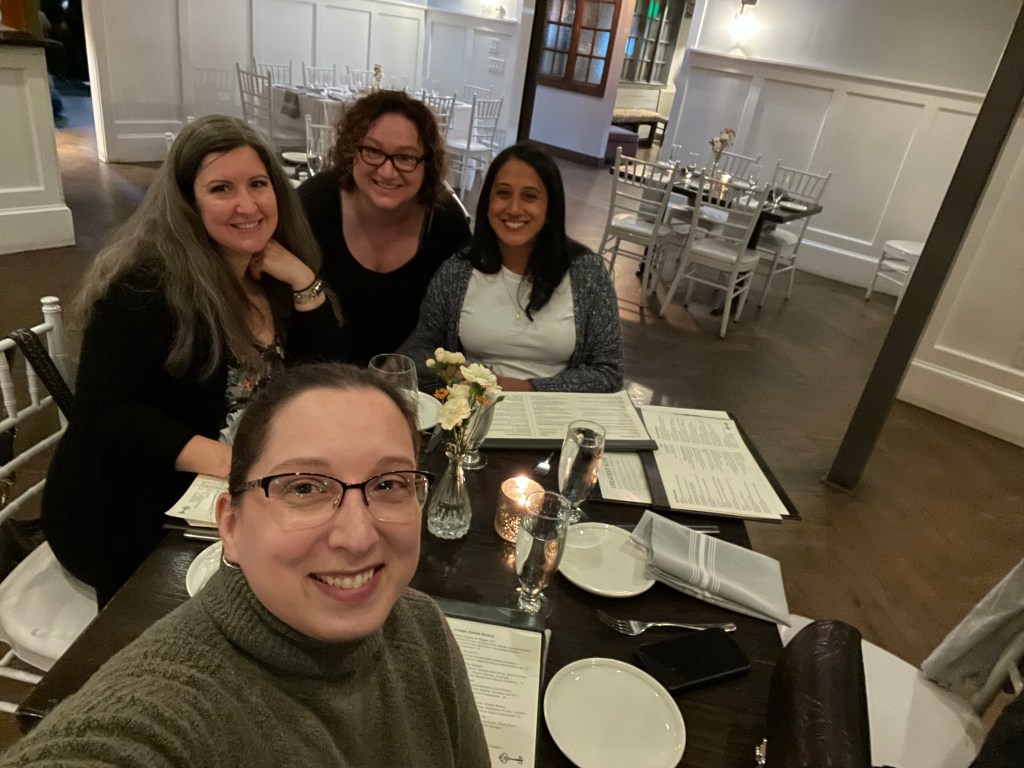
A quick trip to the grocery store involved more walking than I wanted to do, but was unavoidable. When we got back to the house, I settled on the couch in the living room, where we caught up on more gossip until one in the morning. My throat was painful and stretched tight by the time I headed to bed. Another dose of ibuprofen fixed everything enough to allow me to fall asleep.
On day 2, my entire body reminded me from head to toe that even though I was reminiscing about old times, I was not actually still eighteen. In fact, people with hEDS have bodies that act and feel more like twenty-to-thirty years older than their given age. So yeah. I definitely felt seventy-five that morning. But guess what? Another dose of ibuprofen helped!
And so I physically pushed through the day, walking two and a half miles through the local town, shopping along Main Street and enjoying the time together until we returned home for dinner and cocktails.
“How about we order take-out and eat in tonight?” I suggested. The idea was met with approval. I was grateful, oh so grateful! Did my friends know how much pain I was in? Did they know the reason I wanted to eat in was because I no longer had the energy to be in public any longer? I don’t know. But they agreed. Indian food take-out for the win. Maybe a personal win.
After dinner? The same routine as the night before, except this time we stayed up laughing and talking until TWO a.m. instead of one. My body was aching long before I went to bed, my throat screaming, this time so badly that it felt as though I was coming down with something. (I wasn’t.) So another dose of ibuprofen around ten p.m. and I was set to enjoy the rest of the evening.
It’s a terrible thing to feel sick and not be sick. (I mean, it’s terrible to feel sick and actually be sick, too, but…) Feeling this way takes every moment of joy and stains it with pain. I’ve never resented this disease so much as I did this weekend. It stole from me what should have been an effortless weekend with friends, making me constantly aware of just how hard I was pushing my body and just how long I was going to need to recover when I finally did get home.
Sure enough, a dose of ibuprofen on Saturday night was just what my body needed to pretend to be normal. But two late nights in a row talking and laughing was taking a major toll on my system. I awoke Sunday morning feeling as though I’d been hit by a truck. I’ve never been hungover in my entire life (I don’t really drink much), but I felt quite sure that this is what it must feel like. Another dose of, you guessed it, ibuprofen, and an hour later I felt ready to face the day.

We had a lazy start to the day, spent an afternoon walking along the bay, eating lunch at another amazing restaurant, and taking a brief shopping trip to Trader Joe’s. (We don’t have one near us. What a novelty!) By the time we got home, my entire body was, once again, screaming.
Funny thing about hEDS. I can push hard for a day, but then I have less reserve for the following day. Pushing hard for two days means even less left in my energy tank, and for three days even less than that. For people with chronic illness, it’s all about those spoons.
Nevertheless, knowing that this was our last night, I did the dumb thing, pushed through, and stayed up until one a.m. yet again, completely aware that my drive home was going to be an exceptionally difficult one. More ibuprofen before bed, and another dose first thing in the morning.
The drive home was hard. My vocal cords were shot, my throat tight and dry, and every muscle in my body ached. One of my friends rode with me, which kept me from thinking too much on my discomfort, but when I got home, everything caught up with me in about ten minutes’ time and I crashed. Unable to attend that night’s school board meeting in person, I called in via teleconference and took part from the warmth and comfort of my bed.
I continued to crash most of the next day, getting up to drive kids to school and appointments, and coming home to sleep again. It’s taken the better part of the week for me to regain my voice and even now, it’s still scratchy.
For the record, I’ve stayed away from the ibuprofen since returning home. One of my friends asked over the weekend if I ever varied my pain meds so as not to be so hard on my body, and I had to admit I don’t usually push this hard or need so much in the way of medication. Which is all true.
It’s difficult, though. It’s hard to see people my age with energy reserves vastly different from my own — ready to go out, able to stay up late and not feel terrible the next day, fine with walking miles upon miles several days in a row. It’s hard to see them so active and know I can’t be. On a regular day-to-day basis, my condition doesn’t bother me, but when I can’t keep up (or I pay dearly for trying to keep up), it’s eye-opening.
Still worth it? Hell, yes. The warmth and belonging felt by connecting with friends from long ago will always outweigh the physical hardships of travel and activity for me.
I’m learning, though. I’m learning how to say, “This is my limit” or “I can’t.” And the people who love me? Accept my limitations without bias.
True friends, through and through.
Oh, and also?
 L. Ryan Storms